The biblical meaning of the name Alyssa traces back to profound spiritual themes of grace and purity, nobility of character, and a sound mind, all gifted by God, drawing on Greek and Germanic roots that align beautifully with Scripture’s deepest values.
Here’s what’s remarkable: a name doesn’t need to appear in the Bible to carry biblical significance. Alyssa’s ancient roots quietly echo 2 Timothy 1:7 — God’s gift of a sound, untroubled mind.
Beyond etymology, Alyssa’s spiritual meaning reflects godly character, inner peace, and faithful devotion — qualities Scripture celebrates in its most courageous, grace-filled women.
Where Does the Name Alyssa Actually Come From?

Understanding the origin of the name Alyssa requires pulling two threads: one Greek, one Germanic. Most name articles blur these together. They shouldn’t.
The Greek Root — A Mind Free From Madness
The name Alyssa connects directly to the flowering plant Alyssum — and that plant’s name comes from the Greek a- (without) + lyssa (rage, madness, frenzy). Literally, Alyssa means “without madness” — or more beautifully put, one of calm and rational spirit.
This wasn’t a minor idea in ancient Greek culture. Lyssa was actually personified as a spirit of mad rage and frenzy in Greek mythology. So to be a-lyssa was to be free from that — composed, sound, clear-minded.
Sound familiar? It should.
For God has not given us a spirit of fear, but of power, of love, and of a sound mind.— 2 Timothy 1:7 (NKJV)
The Greek origin of Alyssa maps almost perfectly onto this verse. Spiritual clarity, calm under pressure, a mind rooted in God’s peace rather than chaos — that’s the etymological heartbeat of this name.
The Germanic Root — Noble by Character, Not by Birth
Alyssa also descends from the Germanic name Adalheidis — the ancestor of Adelaide and Alice — which breaks into adal (noble) and heid (kind, sort, type). Translation: “of noble kind“ or “noble character.”
This is critical. The Germanic tradition didn’t define nobility by bloodline alone. It defined it by how you carried yourself — your integrity, your dignity, your moral fiber. This connects powerfully to biblical values around Godly character and righteous living.
The evolution of the name looks like this:
| Stage | Name Form | Meaning Emphasis |
|---|---|---|
| Ancient Germanic | Adalheidis | Noble character/kind |
| Medieval Latin | Adela / Adelaide | Noble, gracious |
| Old French | Alicia | Noble kind |
| Modern English | Alyssa | Noble + calm spirit |
So the Alyssa name meaning carries two roots — spiritual clarity from the Greek and nobility and honor from the Germanic — both of which align remarkably well with biblical character traits.
Is Alyssa a Biblical Name? Here’s the Honest Answer
Let’s be straightforward: Alyssa doesn’t appear in the Bible. No character carries that name in the Old or New Testament.
But here’s what matters — a name doesn’t need to appear in Scripture to carry biblical meaning. The themes embedded in Alyssa’s etymology show up everywhere in God’s Word. Purity and holiness, grace and purity, godly wisdom, faithful devotion, a peaceful spirit — these aren’t vague spiritual buzzwords. They’re woven into the very roots of what this name means linguistically.
Think of it this way: the word trinity doesn’t appear in the Bible either. But the concept saturates it. The same principle applies here.
The Biblical Themes Embedded in the Name Alyssa
Grace — The Foundation of Everything
The Germanic root of Alyssa carries the sense of gracious nobility — generosity of spirit, kindness extended without condition. That’s essentially the definition of biblical grace.
Grace in Christianity isn’t just a theological concept. It’s a way of moving through the world. Paul writes in Ephesians 2:8:
“For it is by grace you have been saved, through faith — and this is not from yourselves, it is the gift of God.”
An Alyssa who lives out her name’s meaning embodies a grace-filled life — not because she earns it but because she’s formed by it. She extends to others what God has poured into her. That’s biblical grace in motion.
Purity and Holiness — A Clear, Undivided Heart
The word a-lyssa — without frenzy or corruption — carries a secondary implication: purity of mind and motive. In biblical terms, purity of heart means an undivided devotion to God. Jesus said:
“Blessed are the pure in heart, for they will see God.” — Matthew 5:8
Purity in the Bible isn’t about perfection. It’s about direction — a heart aimed consistently toward God, unclouded by double-mindedness. Purity and holiness are the natural habitat of someone shaped by what Alyssa’s name means. Peter puts it plainly in 1 Peter 1:15-16:
“But just as he who called you is holy, so be holy in all you do; for it is written: ‘Be holy, because I am holy.'”
Nobility and Honor — Character as Your Crown
Nobility and honor in Scripture never belong exclusively to royalty. They belong to anyone who walks with unwavering faith and righteous character. Proverbs 22:1 declares:
“A good name is more desirable than great riches; to be esteemed is better than silver or gold.”
The Alyssa biblical meaning — rooted in noble character — points toward exactly this. Your name isn’t your inheritance. Your character is. That’s the biblical womanhood principle in one sentence.
The Alyssum Flower — A Living Symbol of the Name
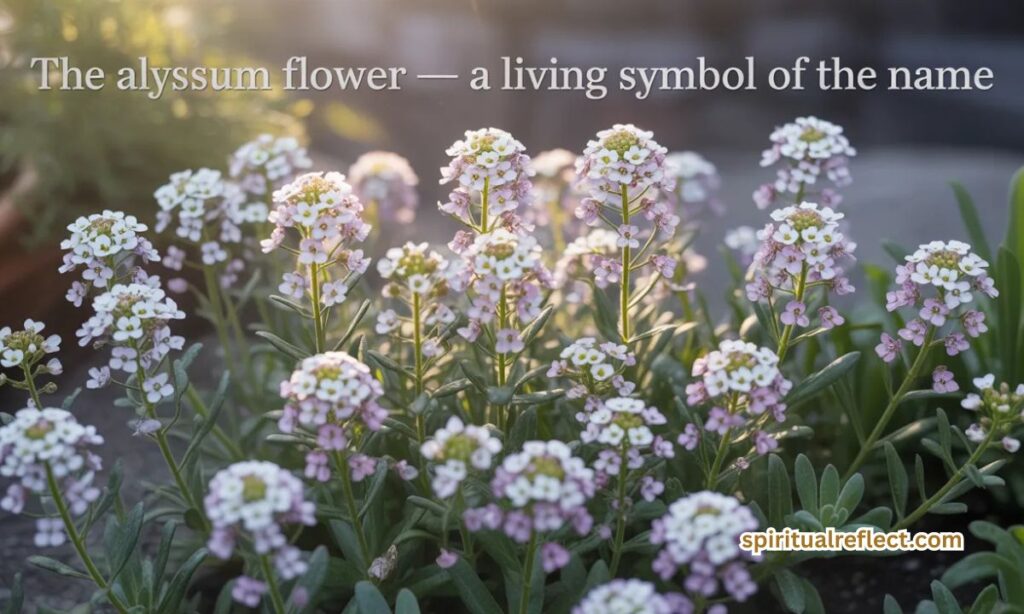
The Alyssa flower meaning deserves its own section. Sweet alyssum (Lobularia maritima) is a real, documented flowering plant whose symbolism adds a gorgeous visual layer to everything the name means.
Here’s what makes the alyssum flower symbolism so striking:
- Color: Sweet alyssum blooms in white, purple, and pale pink — colors associated in Scripture with purity and holiness, royalty, and grace and kindness
- Growth pattern: It doesn’t grow tall and showy. It spreads low and wide, carpeting the ground in quiet, fragrant abundance — a living picture of a humble spirit and strength in gentleness
- Language of flowers (floriography): In the Victorian tradition of flower symbolism, alyssum represents “worth beyond beauty” and excellence of character
Isaiah 1:18 pairs beautifully here:
“Though your sins are like scarlet, they shall be as white as snow.”
White alyssum blooms whisper God’s promises of cleansing, renewal, and a life rooted in faith. If Alyssa is your name, the flower that shares your roots is quietly extraordinary — beautiful without being loud about it.
Faithful Women in the Bible Who Lived the Meaning of Alyssa
These women aren’t named Alyssa. But they embodied every theme her name carries — and studying them gives us a flesh-and-blood picture of what biblical meaning of Alyssa looks like walked out in real life.
Abigail — Calm Wisdom in the Middle of a Crisis
Abigail is the most etymologically accurate parallel to Alyssa’s Greek root — yet most competitors skip her entirely. That’s a mistake.
In 1 Samuel 25, Abigail’s husband Nabal was a reckless fool who insulted David. David was riding to kill every male in Nabal’s household. While everyone around her panicked, Abigail moved with calm confidence, rational planning, and extraordinary grace. She de-escalated a potentially catastrophic situation through wisdom and discernment and a well-chosen gift.
David’s response? He told her directly: “May you be blessed for your good judgment” (1 Samuel 25:33). The Hebrew phrase there essentially means “good understanding” — a sound mind. That’s a-lyssa in its purest biblical expression.
What Abigail teaches us: A quiet strength and composed spirit can accomplish what aggression never could.
Ruth — Noble Loyalty in Real Life
Ruth’s famous declaration in Ruth 1:16 is one of the most striking displays of loyal love in all of Scripture:
“Where you go I will go, and where you stay I will stay. Your people will be my people and your God my God.”
Ruth wasn’t born into Israel’s covenant. She chose it — abandoning her homeland, her family, and her security for faithful devotion to Naomi and obedience to God. That’s nobility and honor of spirit, not bloodline. It’s Godly character expressed through costly, daily choices.
What Ruth teaches us: Biblical faithfulness isn’t a feeling. It’s a decision you make again every morning.
Esther — Composed Courage for Such a Time as This
Esther 4:14 may be the most famous verse about spiritual purpose and biblical destiny in the entire Old Testament:
“And who knows but that you have come to your royal position for such a time as this?”
What makes Esther remarkable isn’t just her bravery. It’s her composure. When Mordecai revealed the plot to destroy her people, Esther didn’t spiral. She fasted, prayed, prepared, and then moved with deliberate courage and nobility. She acted with the a-lyssa quality — without panic, without rage, without impulsiveness.
What Esther teaches us: Calm confidence anchored in trusting God’s plan is more powerful than frantic action.
Mary of Bethany — Purity of Focus
In Luke 10:38-42, while her sister Martha bustled around with a hundred preparations, Mary sat at Jesus’ feet and listened. Jesus said she had chosen “what is better, and it will not be taken away from her” (v.42).
Mary’s purity of heart — her undistracted, undivided attention toward God — is a biblical reflection of what Alyssa’s name points toward. She wasn’t passive. She was focused. In a noisy world, that kind of sincere devotion is rare and precious.
What Mary teaches us: A heart surrendered to God isn’t complicated. It just requires choosing him over the noise.
The Personality of an Alyssa — What Her Name Suggests
Drawing from the name’s etymology — not horoscopes, not guesswork — here’s the personality portrait the meaning of the name Alyssa paints:
| Trait | Root of the Trait | Biblical Parallel |
|---|---|---|
| Emotionally grounded | Greek: a-lyssa (without frenzy) | 2 Timothy 1:7 |
| Quietly wise | Germanic: noble kind | Proverbs 31:10 |
| Generous by nature | Grace in the name’s heritage | Colossians 3:13 |
| Principled and steady | Noble character | Proverbs 22:1 |
| Compassionate | Heid — kindness of kind | Micah 6:8 |
These aren’t just faith-based personality traits that sound nice. They’re callings. Every Alyssa carries these themes as an invitation to become what her name already declares her to be.
Alyssa meaning and personality boil down to this: she’s not the loudest voice in the room. She’s the steadiest one. Others run to her when the world gets chaotic — because something about her presence brings inner peace and faith into a turbulent moment.
What the Name Alyssa Declares Over Your Life

In Hebrew culture, a name was a prophecy spoken at birth. Parents didn’t just pick sounds they liked — they named their children into a future. Even Greco-Germanic names like Alyssa carry this weight when filtered through a biblical worldview.
Consider what these Scriptures say about identity and naming:
“Before I formed you in the womb I knew you, before you were born I set you apart.” — Jeremiah 1:5
“For you created my inmost being; you knit me together in my mother’s womb.” — Psalm 139:13
Spiritual name interpretation isn’t about magic. It’s about recognizing that God works through the ordinary — including the names our parents chose — to speak purpose into our lives. The spiritual meaning of Alyssa declares:
Encouragement for Every Woman Named Alyssa
If your name is Alyssa, here’s what God’s Word — filtered through the beautiful roots of your name — might be saying directly to you:
When life gets overwhelming: You were literally named for the absence of madness. The God’s peace that Paul describes in Philippians 4:7 — “which transcends all understanding” — is your spiritual inheritance. Lean into it.
When you doubt your worth: Your name declares noble character. Not noble status. Not noble accomplishments. Character — the part of you no one can take away. Proverbs 31:25 says: “She is clothed with strength and dignity.” That’s you.
When grace feels hard to give: Remember where your name comes from. It carries gracious generosity in its oldest Germanic form. Colossians 3:13 says: “Bear with each other and forgive one another.” You weren’t just told to do this — you were named for it.
When purity feels like pressure: Purity in your name isn’t a performance standard. It’s a direction — a heart surrendered to God, consistently pointed toward him. That’s enough.
These aren’t generic biblical encouragement for women talking points. They’re yours, rooted in your specific name.
How to Actually Live Out the Meaning of Alyssa

Biblical inspiration for names is only useful if it translates into daily life. Here’s how the Alyssa biblical meaning becomes practical:
Cultivate your sound mind:
- Daily Scripture meditation anchors you in spiritual clarity (Psalm 119:105)
- Practice stillness — Psalm 46:10: “Be still, and know that I am God.”
- Limit inputs that produce chaos and frenzy
Walk in noble character:
- Luke 16:10: “Whoever is faithful in very little is also faithful in much” — walking in integrity starts in small moments
- Choose the principled path even when no one’s watching
Extend grace generously:
- Colossians 3:13 — forgive as the Lord has forgiven you
- Strength in gentleness isn’t weakness. It’s the hardest kind of power
Be the alyssum in your community:
- The flower doesn’t tower over others. It spreads quietly, beautifully, fragrantly
- A servant heart and humble spirit create more lasting influence than a platform ever could
Pray into your name: A simple, powerful practice: take the themes of your name into prayer. “Lord, let me carry the calm you placed in my name. Let me live the nobility you’ve called me to. Let me give the grace that first found me.” That’s spiritual growth in a sentence.
Your Name Is Not an Accident
Here’s the bottom line — and it matters.
The biblical meaning of the name Alyssa isn’t a nice story someone invented to make parents feel good about the name they picked. It’s a real etymological trail that leads back to purity and holiness, grace and kindness, nobility and honor, and the kind of peaceful spirit that 2 Timothy 1:7 describes as a direct gift from God.
You weren’t handed this name randomly. Whether your parents knew its meaning or not, God did. And Proverbs 22:1 still stands:
“A good name is more desirable than great riches; to be esteemed is better than silver or gold.”
Alyssa is a good name. Not because it sounds beautiful — though it does. But because it means something. It calls you toward righteous living, spiritual maturity, faithful devotion, and a God-centered life built on grace you didn’t earn and nobility you grow into, one quiet, faithful choice at a time.
Don’t just carry the label. Live the meaning.
Conclusion
The amazing biblical meaning of the name Alyssa is genuinely breathtaking. It declares grace, nobility, and a sound mind over every woman who carries it. Your name isn’t random. It’s a quiet prophecy spoken before you understood what it meant.
Living out the amazing biblical meaning of the name Alyssa starts today. Choose calm over chaos. Walk in noble character. Extend grace freely. God didn’t give you this name by accident — He gave it as an invitation. Now go live it fully.
FAQs
What is the amazing biblical meaning of the name Alyssa?
Alyssa means “noble character” and “sound mind” — themes deeply rooted in grace, purity, and godly wisdom throughout Scripture.
Is Alyssa a Hebrew name?
No. Alyssa comes from Greek (a-lyssa) and Germanic (adal-heid) roots — but its spiritual themes align perfectly with biblical values and Christian faith.
What flower represents the name, Alyssa?
Sweet alyssum (Lobularia maritima) shares the name’s Greek roots and symbolizes worth beyond beauty, purity, and excellence of character.
Which biblical women best reflect the meaning of Alyssa?
Abigail, Ruth, Esther, and Mary of Bethany each embodied Alyssa’s core themes — calm wisdom, noble loyalty, courage, and purity of devotion.
Is Alyssa a good Christian name for a baby girl?
Absolutely. Among Christian baby girl names, Alyssa stands out for its rich spiritual meaning — declaring grace, nobility, and a God-given peaceful spirit over your daughter’s life.